Longrun steel is the most common roofing material on Auckland homes for good reason: it is light, it sheds heavy rain quickly and, specified correctly, it lasts for decades. The words that matter are "specified correctly". The same profile in the same colour can perform very differently on a sheltered section in Mt Roskill and on a clifftop in Murrays Bay, so we start every job by working out what your roof is actually up against.
We supply and install COLORSTEEL longrun in corrugate and trapezoidal profiles for re-roofs, new builds and extensions. Most longrun work is part of a full re-roofing project, where the old roofing, underlay and flashings all come off together. If you are still weighing up materials, the guide to COLORSTEEL colours covers how colour affects heat, looks and covenants.
Pricing: every roof gets a free on-site measure and an itemised written quote, with a fixed price agreed before any work starts.
What longrun roofing is made of
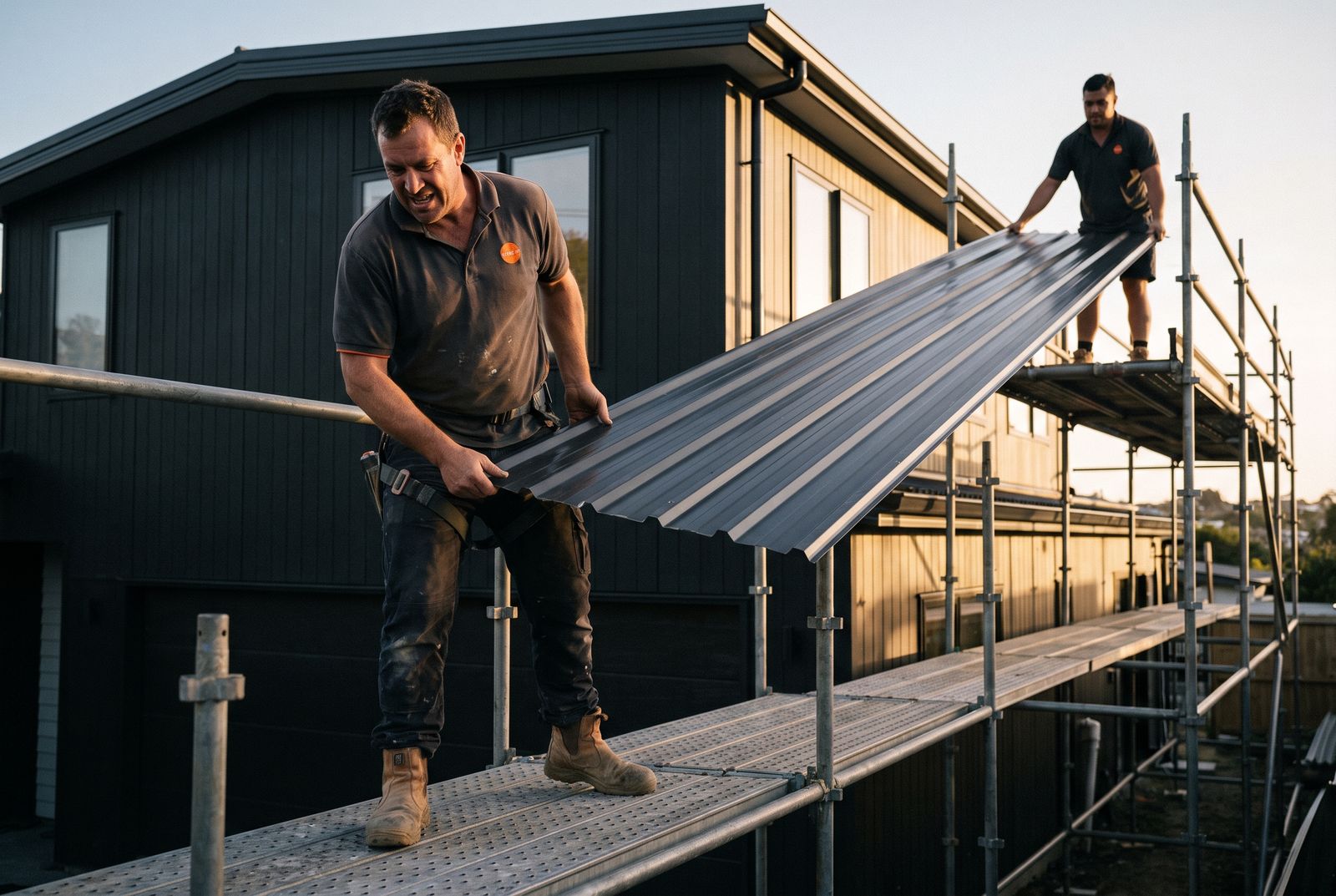
A longrun roof is a set of steel sheets roll-formed to the full length of each roof plane, so most runs have no end laps where water could track back. The sheets are fixed to purlins or battens over a roofing underlay, with ridging, barge flashings, apron flashings and valleys folded from matching steel to close every edge and junction.
COLORSTEEL is the pre-painted steel brand made in New Zealand. Its current range is built around two products. COLORSTEEL MAXAM is designed for most New Zealand environments, from inland suburbs through to many coastal sites. COLORSTEEL ALTIMATE is designed for extremely severe marine and breaking surf environments. COLORSTEEL rates sites on a five-step scale from Mild to Extremely Severe, and asks that any site within 100 metres of salt water be confirmed with them before the product is chosen.
- Corrugate: the classic wave profile, suited to bungalows, villas and most pitched roofs
- Trapezoidal: taller, squarer ribs that carry more water and suit lower pitches and longer runs
- Underlay: a breathable layer under the steel that manages condensation and any wind-driven moisture
- Flashings and ridging: folded steel that seals the ridge, edges, walls, chimneys and roof penetrations
Choosing a profile: pitch and run length decide more than looks
Every profile has a minimum pitch it can be laid at, and longer runs need more water-carrying capacity. The NZ Metal Roof and Wall Cladding Code of Practice sets these out. For standard 16.5 mm corrugate the minimum cladding pitch is 8 degrees, while deeper trapezoidal profiles can go down to 3 or 4 degrees depending on rib height. The Code also flags when the capacity of the profile needs checking on long runs.
In practice that means a low-pitch extension or a long skillion roof will often need a trapezoidal profile even if the rest of the house is corrugate. We measure the actual pitch on site rather than relying on plans, because older Auckland homes are rarely exactly what the drawings say. Where a section of roof is too flat for any profiled steel, a membrane roofing system is usually the right answer for that part.
How It Works
Matching the steel to your exposure zone
Salt spray is the main thing that shortens the life of a steel roof in Auckland. With harbours on both sides of the isthmus, the Hauraki Gulf to the east and the west coast surf beyond the Waitākere Ranges, a surprising number of homes sit in a coastal exposure zone. COLORSTEEL publishes distance bands and environment categories, and BRANZ Maps lets you look up the NZS 3604 corrosion and wind zones for an address.
Exposure also changes the maintenance that keeps the warranty valid. COLORSTEEL's warranty table relies on rain washing for roofs in milder environments but calls for manual washing of sheltered areas more often as exposure rises, with accessories in very severe environments needing attention as often as monthly. We tell you which category your site falls in and what that means for upkeep before you sign, not after. Our roof cleaning page explains how that washing is done safely.
What affects the price of a longrun roof
We do not publish a per square metre rate, because two roofs with the same floor area can differ a lot in cost. Your written quote is itemised so you can see where the money goes. The main drivers are:
- Roof area measured on the slope, not the house footprint
- Pitch and complexity: hips, valleys, dormers and multiple levels add flashings and labour
- Steel product and profile chosen for your exposure zone
- Access and scaffolding, especially on two-storey or sloping sections
- Removal and disposal of the old roof, and whether asbestos or decramastic is involved
- Replacement of rotten purlins, battens or fascia found once the old roof is off
Consent, licensing and the Building Code
Replacing an existing roof with a comparable material in the same position is often exempt from building consent under Schedule 1 of the Building Act, provided the old roof has met its Building Code durability requirement. Roof cladding is in the 15-year durability category, so a roof that failed early, or a change in structure or material, can mean consent is needed. Where consent is required for a home, roofing that affects weathertightness is restricted building work and must be carried out or supervised by a Licensed Building Practitioner.
We confirm which path applies to your house before we quote. Our roofing FAQ covers the common Auckland consent scenarios in more detail.
Longrun on new builds and extensions
For new homes, minor dwellings and additions we install to the consented plans and supply the documentation your builder and Auckland Council need for the Code Compliance Certificate. If you are building, see our new roofs page for how we work alongside your builder and the inspection stages involved.
Why Choose Cheeky's Roofers for Metal Roofing
Steel chosen for your site
We identify your exposure category and confirm coastal sites with the manufacturer before specifying MAXAM or ALTIMATE.
Pitch measured, not assumed
Profile choice is based on the pitch and run length we measure on your roof, checked against the Code of Practice minimums.
Itemised written quote
Area, profile, flashings, scaffolding, removal and allowances for hidden timber are listed separately so quotes are easy to compare.
Maintenance explained up front
You get the washing schedule your warranty depends on, in plain language, before work starts.
Metal Roofing FAQs
How long does a COLORSTEEL roof last?
It depends on the product, the exposure zone and maintenance. COLORSTEEL publishes warranties by environment category, and the Building Code requires roof cladding to last at least 15 years. We explain the warranty that applies to your site in the quote.
Is corrugate or trapezoidal better?
Neither is better everywhere. Corrugate suits most pitched roofs and traditional homes. Trapezoidal carries more water, so it suits lower pitches and long runs. The minimum pitch for each profile is set out in the NZ Metal Roof and Wall Cladding Code of Practice.
My house is near the beach. Which COLORSTEEL should I use?
COLORSTEEL MAXAM covers most environments, and ALTIMATE is designed for extremely severe marine and breaking surf sites. Anything within 100 metres of salt water should be confirmed with COLORSTEEL, which we do as part of the quote.
Will a steel roof be noisy in the rain?
A properly fixed roof over underlay and ceiling insulation is not noticeably loud inside most homes. Rattles usually come from loose fixings or worn washers, which a new roof eliminates.
Do I need building consent for a new longrun roof?
Like-for-like replacement of a roof that has met its durability requirement is often exempt. Changes to structure or material, or a roof that failed early, can need consent. We check before quoting.
Can you match an existing roof colour on an extension?
We can match the colour name, but new steel will look brighter than a roof that has weathered for years. We show you samples against the existing roof so you can decide.
Metal Roofing by Area
Local metal roofing information for your part of Auckland:
Related Roofing Services
Metal Roofing Guides
- Concrete Tile vs Steel Roof: Which Is Better in NZ?
- How Much Does COLORSTEEL Roofing Cost in NZ? (2026)
- Roof Pitch Calculator and Minimum Pitches for NZ Roofs
See the re-roofing cost guide or every service we offer.