
A well-built tile roof can give decades of service, and the tiles themselves are often the last thing to fail. What wears out first is everything around them: the mortar bedding and pointing on ridges and hips, the fixings, the valley irons, and the underlay beneath. Repairing those parts properly can add years to a tiled roof.
We repair concrete and clay tile roofs across Auckland. Tile roofs need a different approach from steel: they have to be walked on carefully, tiles must be matched or sourced, and leaks travel under the tiles before they show. If your tiled roof needs more than repairs, our tile to metal re-roofing page covers the alternative.
Pricing: every roof gets a free on-site measure and an itemised written quote, with a fixed price agreed before any work starts.
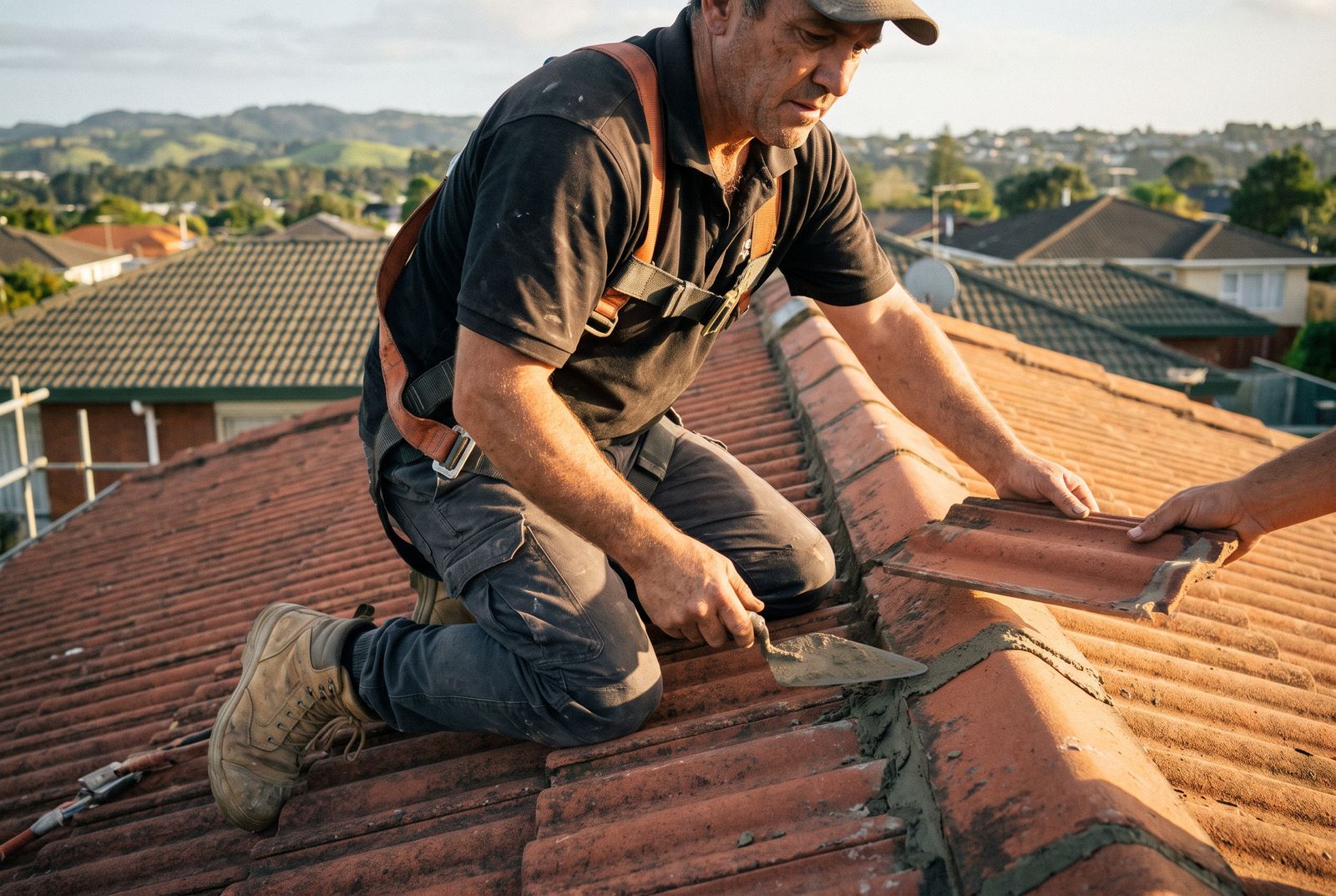
Common problems on tile roofs
Most tile roof problems show up in a few predictable places. Ridges and hips are capped with tiles held in mortar bedding, and over time that mortar cracks and lets the caps rock and leak. Individual tiles crack from foot traffic, falling branches or age. Tiles slip when their fixings fail. Valleys, where two roof planes meet, carry a lot of water and clog with leaves and moss.
- Cracked or broken tiles, often from someone walking on the roof
- Slipped or missing tiles leaving gaps in the roof
- Cracked or missing mortar bedding and pointing on ridges and hips
- Loose ridge caps that move when touched
- Rusted or blocked valley irons
- Moss and lichen holding water and lifting tile edges
- Brittle or torn underlay under the tiles
Ridge rebedding and repointing
Ridge and hip work is the most common tile roof repair. Repointing means applying a new flexible pointing compound over sound bedding to seal the caps. Rebedding goes further: the ridge caps are lifted, the old cracked bedding is removed, and the caps are re-laid on fresh bedding and fixed, then pointed.
Which you need depends on the bedding underneath. Pointing over loose bedding only hides the problem, so we lift a section to check before recommending one or the other. On exposed sites with strong wind, mechanical fixing of ridge caps adds security.
How It Works
Replacing cracked and slipped tiles
A single cracked tile can let in a surprising amount of water in wind-driven rain. Replacing it means lifting the surrounding tiles, removing the broken one and fitting a match, then checking the underlay beneath for damage.
Matching is the main challenge on older roofs. Many concrete tile profiles are no longer made, so we may source second-hand tiles of the same profile, or take sound tiles from a less visible part of the roof and fill those gaps with the closest available match. New tiles will look brighter than weathered ones for a while. We confirm what match is possible before we quote.
Leaks, valleys and moss
Leaks on tile roofs are rarely as simple as a visible broken tile. Water can track under laps and along battens before reaching the ceiling, so we trace from inside the roof space where possible. Rusted valley irons and blocked valleys are common sources, as are failed flashings where the tiles meet walls and chimneys. Our roof flashing repairs page explains those details.
Moss and lichen hold moisture on tiles and can lift edges enough to let wind-driven rain in. Cleaning helps, but be careful with water blasting: it can damage the surface of older concrete tiles and drive water under laps. If your roof is decramastic rather than concrete or clay, do not water blast at all until it has been tested for asbestos. See roof cleaning and moss treatment for the right approach.
When repairs stop making sense
Tile repairs are good value when the problems are local. When ridges need rebedding again, tiles crack every time someone goes up, the underlay has broken down across the roof or the valleys are rusted through, the cost of repeated repairs starts to rival a re-roof. Building Code clause B2 sets a 15-year minimum life for roof cladding, but how much life remains in your roof is best judged from an inspection. We will show you the evidence and, where relevant, price both options. Our roof replacement guide covers the decision.
Why Choose Cheeky's Roofers for Tile Roof Repairs
We walk tiles properly
Our team knows where to step on a tile roof, so fixing one problem does not create three more.
Bedding checked, not covered over
We lift a section of ridge before deciding between repointing and rebedding.
Tile matching sorted up front
We confirm what replacement tiles are available before quoting, so you know how the repair will look.
Photos from both sides
You get photos of the tiles and, where accessible, the underlay and battens from the roof space.
Tile Roof Repairs FAQs
What is the difference between repointing and rebedding?
Repointing seals over existing sound bedding. Rebedding replaces the bedding underneath the ridge caps. If the bedding is cracked or loose, repointing alone will not last.
Can you match my old roof tiles?
Often, using second-hand tiles of the same profile or by moving tiles from less visible areas. Some older profiles are hard to find, and we confirm before quoting.
Should I water blast my tile roof?
Not without care. High pressure can damage older concrete tile surfaces and force water under laps. Decramastic roofs must not be water blasted until tested for asbestos.
Why do my tiles keep cracking?
Most cracking is caused by foot traffic from tradespeople, aerial installers and others. Tiles must be walked on at specific points.
Is it worth repairing a tile roof or should I go to steel?
If the problems are local, repair. If underlay, valleys and ridges are all failing, a tile to metal re-roof may be better value over time.
Do tile roof repairs need consent?
Generally not. Repairs and like-for-like replacement of components are usually exempt from building consent.
Tile Roof Repairs by Area
Local tile roof repairs information for your part of Auckland:
Related Roofing Services
Tile Roof Repairs Guides
- Concrete Tile vs Steel Roof: Which Is Better in NZ?
- Decramastic Roofs: Lifespan, Asbestos and Replacement Options
- Roof Repair Costs in NZ: What Common Fixes Cost
See the re-roofing cost guide or every service we offer.
Sources and further reading
- MBIE building.govt.nz: B2 Durability
- MBIE building.govt.nz: Exemption 1, general repair, maintenance and replacement
- WorkSafe: Check for asbestos before high-pressure spraying on roofs
- WorkSafe: Roof restoration and maintenance
- BRANZ Build 168 via MBIE Code Hub: Replacing a concrete or masonry tile roof