
Flashings are the shaped strips of metal that seal the joints in a roof: where it meets a wall, a chimney, a skylight, another roof plane, or a pipe coming through. They do the hardest job on the roof, and when water gets into a house from above, a flashing is very often involved.
Flashing repair is detail work. A flashing has to shed water, allow the roof to move with heat, and resist wind-driven rain, all at once. A bead of silicone rarely achieves that for long. We repair or remake flashings to the details in the NZ Metal Roof and Wall Cladding Code of Practice. If you have an active leak and are not sure of the cause, start with roof leak repairs.
Pricing: every roof gets a free on-site measure and an itemised written quote, with a fixed price agreed before any work starts.
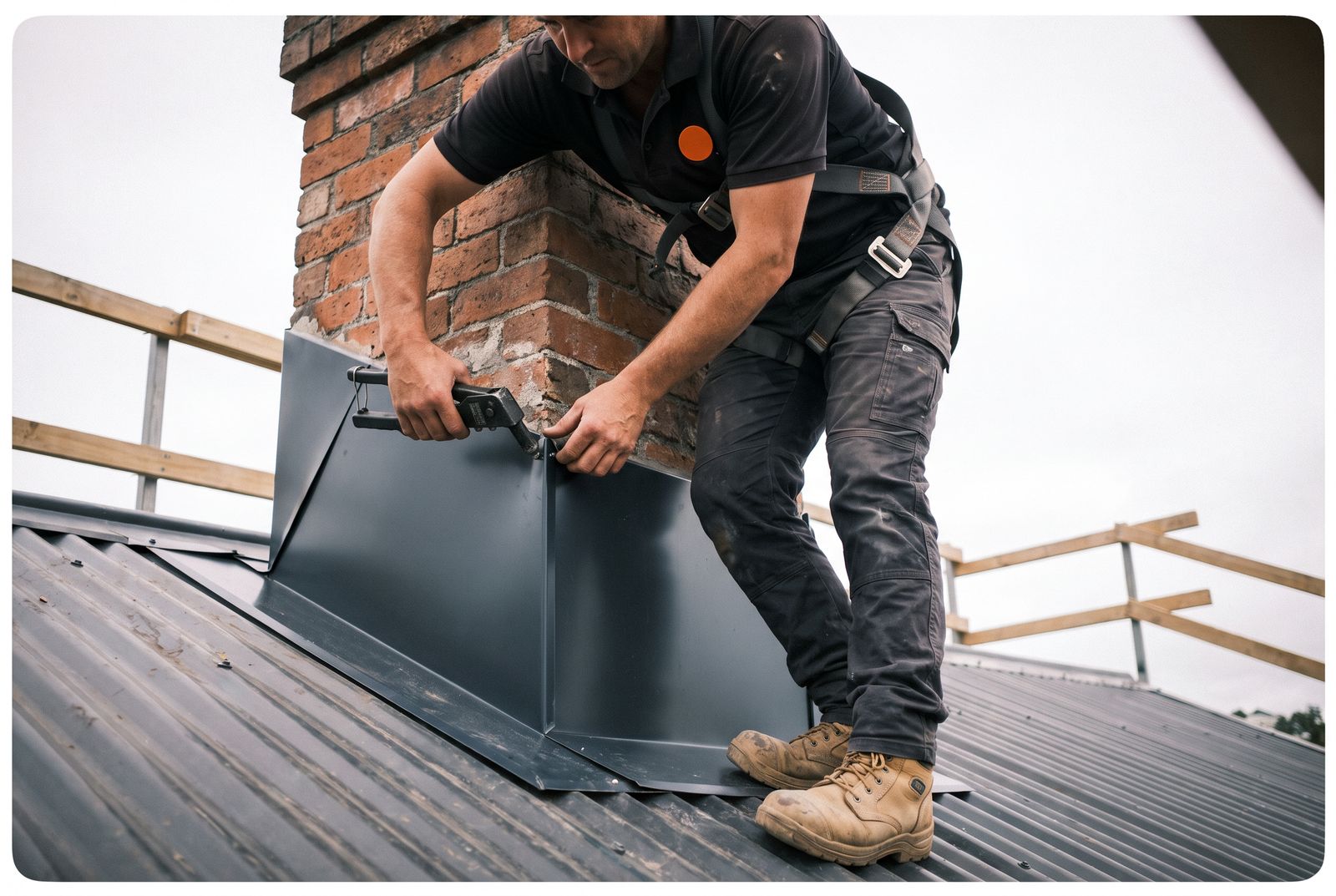
Types of roof flashings
Each flashing has a specific job, and each fails in its own way. Knowing which one you have helps explain why a leak shows where it does.
- Ridge and hip flashings cap the top of the roof and the angled joins between planes
- Barge flashings finish the sloping edges at gable ends
- Apron flashings seal where a lower roof meets a wall
- Valley flashings carry water where two roof planes meet in an internal corner
- Chimney flashings, including back gutters, seal around brick or block chimneys
- Penetration flashings seal around flues, vents, pipes and aerials
- Skylight flashings, usually supplied as a kit, seal around roof windows
Why flashings fail
Some flashings were simply wrong from the start: too short, not turned up enough at the wall, without stop ends or not lapped the right way. Those often leak only in wind-driven rain, which is why the problem can seem intermittent. Others fail with age as fixings loosen, sealants harden and crack, or rubber penetration boots perish in the sun.
Corrosion is a common cause too. Lead, copper and some other metals react with COLORSTEEL and ZINCALUME steel, and water running off an incompatible material onto steel speeds up corrosion. Debris trapped behind chimneys and in valleys holds moisture against the metal. Near the coast, salt that sits on sheltered surfaces such as the underside of flashings, out of reach of rain, also shortens their life.
How It Works
How we repair and replace flashings
We start by finding the failure, from the roof and from the roof space if possible. Small issues, such as a loose fixing or a perished pipe boot, can be repaired on the spot. Where the flashing itself is wrong, too short or corroded, we remove it and make a new one from steel matched to your roof, folded to the correct shape with proper laps, turn-ups and stop ends.
We also supply and fit new roof flashing made to order, for re-roofs, extensions and new skylights as well as repairs. Each one is folded to suit the junction it covers, so it fits first time.
Chimneys need particular care. Many older homes have brick chimneys that are no longer used, and their flashings are a frequent source of leaks. Sometimes the best fix is to remove the chimney below roof level and roof over the gap, which removes the flashing problem completely. We can discuss that option where it makes sense.
Skylight flashings are usually part of a manufacturer kit, and an old skylight may be better replaced than reflashed. Our skylights page covers that work.
Flashings and the Building Code
The Building Code clause E2 External Moisture requires roofs to stop water getting into the building. Flashings are central to meeting it, and the NZ Metal Roof and Wall Cladding Code of Practice, which MBIE lists as an acceptable trade practice, sets out how they should be designed and installed for metal roofs. RANZ and the metal roofing manufacturers also publish an illustrated roofing guide to flashing and penetration details.
Repairing or replacing a flashing with a comparable one in the same position is normally exempt from building consent under Schedule 1 of the Building Act. If the work is part of a larger change, such as removing a chimney, we will check whether consent applies.
Flashings on a roof near the end of its life
New flashings on an old roof can be a good investment if the sheets have years left. If the roofing around the flashing is corroded too, a new flashing fixed into rusting steel will not last, and we will tell you that. On a roof that is close to replacement, every flashing is renewed as part of a re-roof, and our re-roofing page explains how that is done. Ask about a roof inspection if you want a full picture before deciding.
Why Choose Cheeky's Roofers for Roof Flashing
Made to measure, not sealed over
We fold new flashings to suit your roof rather than relying on sealant to bridge a gap.
Compatible metals only
We avoid material combinations that cause corrosion, following the Code of Practice compatibility guidance.
Colour-matched steel
Replacement flashings are made in COLORSTEEL to match your roof where the colour is still produced.
Options for old chimneys
Where a disused chimney is the problem, we will discuss removing it below the roofline as a permanent fix.
Roof Flashing FAQs
Can a leaking flashing just be sealed?
Sometimes as a short-term fix. A flashing that is the wrong shape or length needs to be remade, because sealant alone cannot keep out wind-driven rain for long.
Why does my flashing only leak in strong wind?
Wind pushes water sideways and upwards under flashings that are too short or not turned up enough. That needs a properly sized flashing, not more sealant.
What is a back gutter on a chimney?
It is the flashing on the uphill side of a chimney that collects water and directs it around the chimney. Back gutters often trap debris and corrode.
Can you match my roof colour?
Yes for current COLORSTEEL colours. Older discontinued colours may be a close match.
Do flashing repairs need consent?
Usually not. Replacing a flashing with a comparable one in the same position is normally exempt.
Should I remove my old chimney?
If it is unused and its flashings leak, removal below roof level can be a permanent fix. It depends on the chimney and the house, and we can advise.
Roof Flashing by Area
Local roof flashing information for your part of Auckland:
Related Roofing Services
Roof Flashing Guides
- Roof Repair Costs in NZ: What Common Fixes Cost
- Roof Leaking? How to Find the Source and What to Do First
See the re-roofing cost guide or every service we offer.